VECTOR OPS
Systems design · operational UX · decision support · working software
A working operations coordination system exploring how operators can understand and act on consequences across interconnected operational domains. The public alpha combines an operator interface with a deterministic runtime, structured scenario data, dependency rules, and consequence logic.
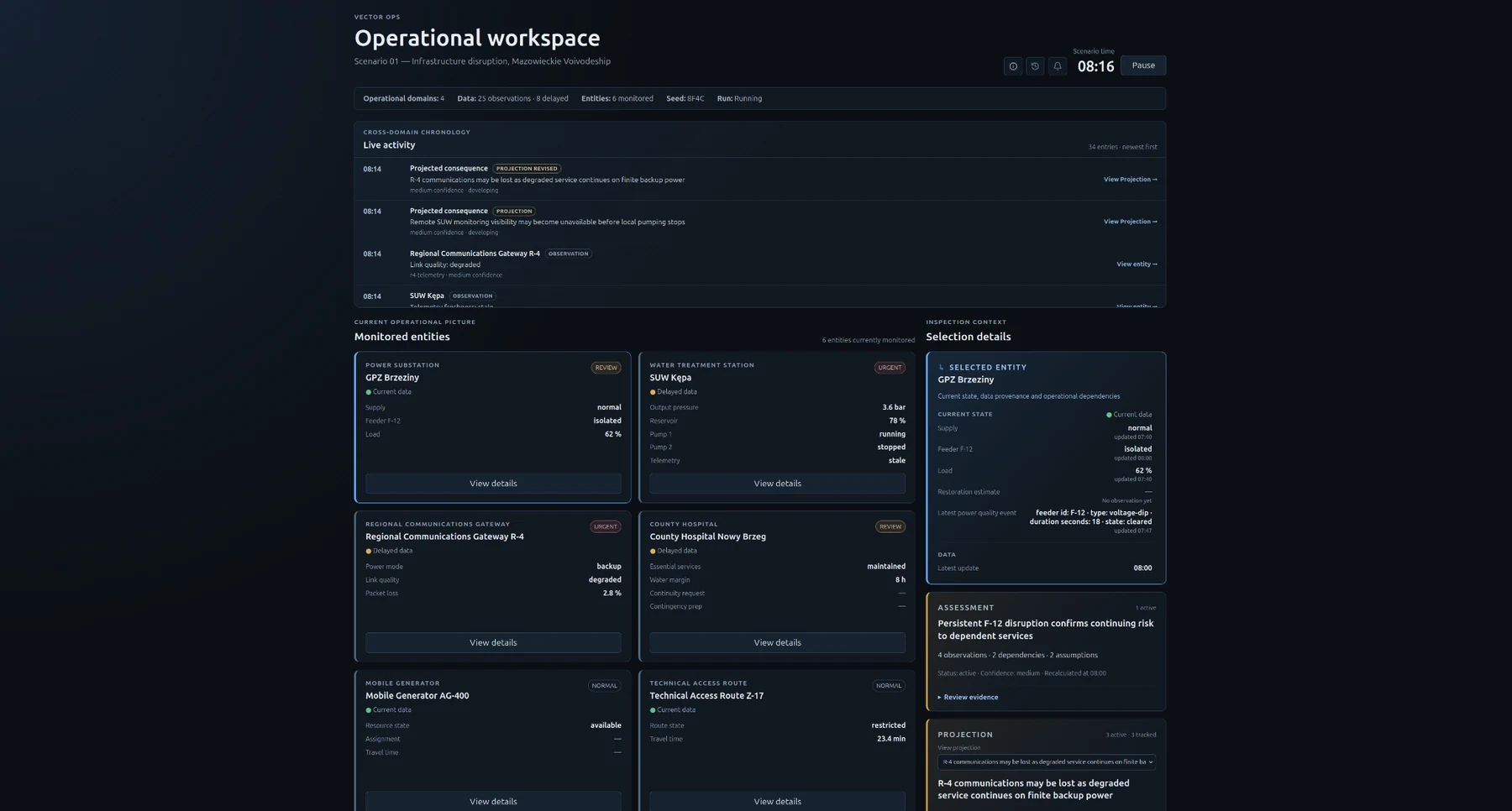
The problem space
Operational teams may work across separate tools for situational awareness, logistics, communications, assets, incidents, and coordination. The design question behind VECTOR OPS is not how to show more data, but how to help an operator understand what requires attention, why it matters, what may become a problem next, and what options are available.
From separate domains to operational consequences
Modules contribute observations about shared entities. Explicit dependencies make it possible to derive assessments and projections across domains, then present decisions in their operational context.
Research before interface
I deliberately started with discovery, adjacent-product research, operator context, problem framing, and system architecture rather than high-fidelity screens.
The research did not support a claim that this is an untouched market. Mature operational platforms already address substantial parts of situational awareness, coordination, and decision support. VECTOR OPS therefore treats cross-domain consequence reasoning and progressive transparency as hypotheses to explore, not as claims of market novelty.
Make consequential reasoning inspectable
The default path stays concise. Evidence and reasoning remain available progressively when uncertainty, consequence, or operator intent makes deeper inspection useful.
- 01StateWhat is happening now?
- 02DependencyWhat is connected?
- 03Projected consequenceWhat may happen next?
- 04OptionsWhat can the operator do?
- 05Expected effectsWhat are the trade-offs?
- 06Operator decisionChoose and record
Narrowing the alpha
The current alpha focuses on one primary operator: a Duty Operations Officer in a Polish Voivodeship Crisis Management Centre. It uses a fictional cascading-infrastructure scenario involving power, telecommunications, water, access constraints, critical services, and limited response resources.
The current scenario, locations, and operational data are synthetic, allowing the system behaviour to be tested and demonstrated without depending on live infrastructure. The alpha does not yet integrate with real public-safety or infrastructure data sources; those integrations sit outside the scope of this release.
Designing around decisions
The current release separates current state, activity, assessment, projection, and operator decisions instead of collapsing them into one generic dashboard. Three bounded decision moments interrupt the scenario when an explicit operator choice is required.
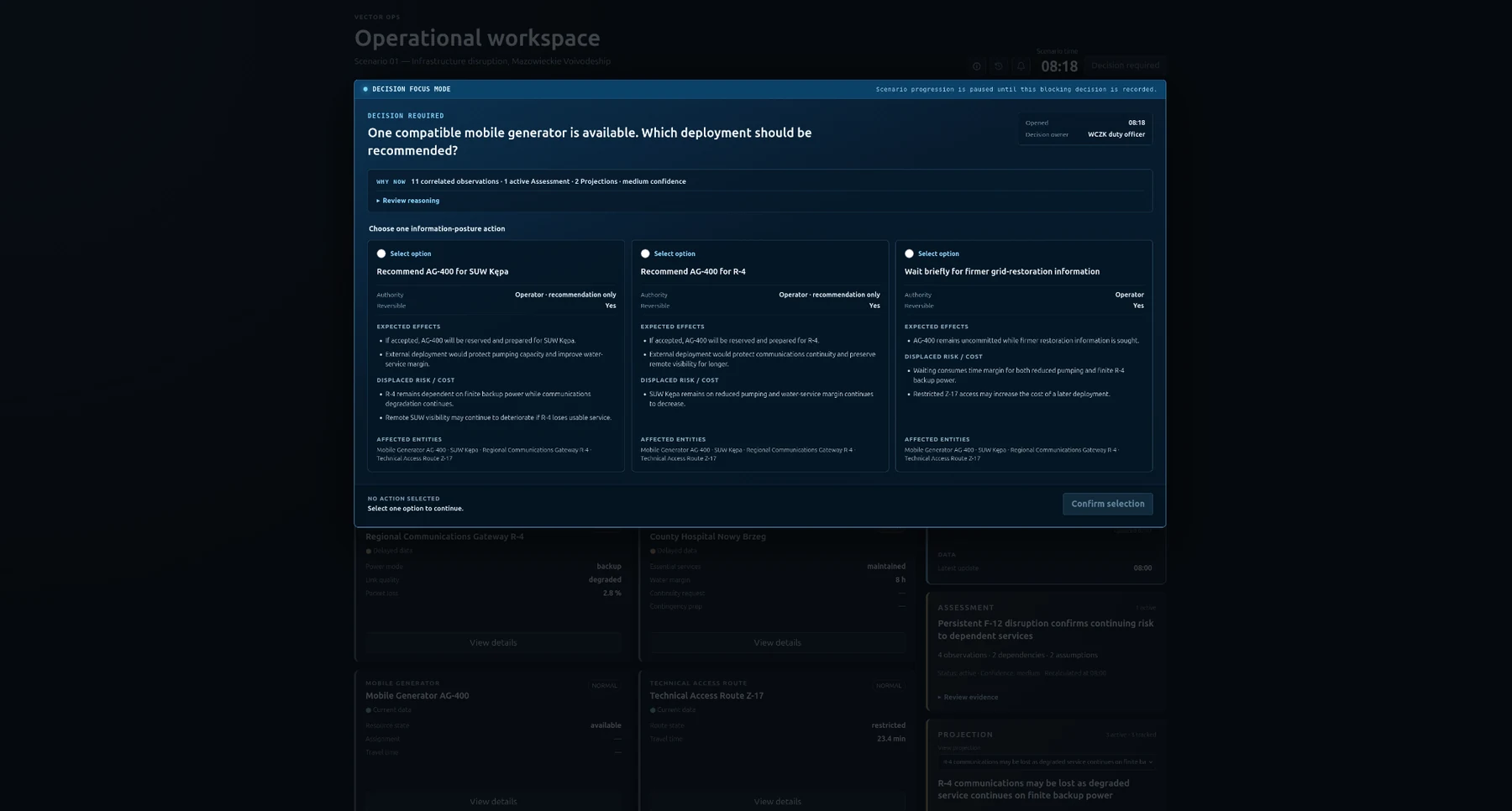
From design model to working software
I built VECTOR OPS as software rather than a static UI prototype because state changes, event propagation, dependencies, and downstream consequences are part of the product logic itself. The interface is one layer over a runtime that processes scenario state, actions, rules, and consequences.
The current implementation uses Astro, React, strict TypeScript, and Vitest. Scenario configuration and runtime rules are deterministic, while the domain logic remains separate from React presentation state. The public build is static and deployed through Cloudflare Pages.
Validation and reconstruction
The current release is tested as a system, not only reviewed as a set of screens. Automated coverage includes every combination of the three decisions for the reference seed, representative fresh-seed runs, deterministic replay, runtime and event behaviour, assessments, projections, completion, and the AAR.
The After-Action Report deliberately avoids an operator score. It preserves what was known at decision time and separates expected effects from effects observed later in the run.
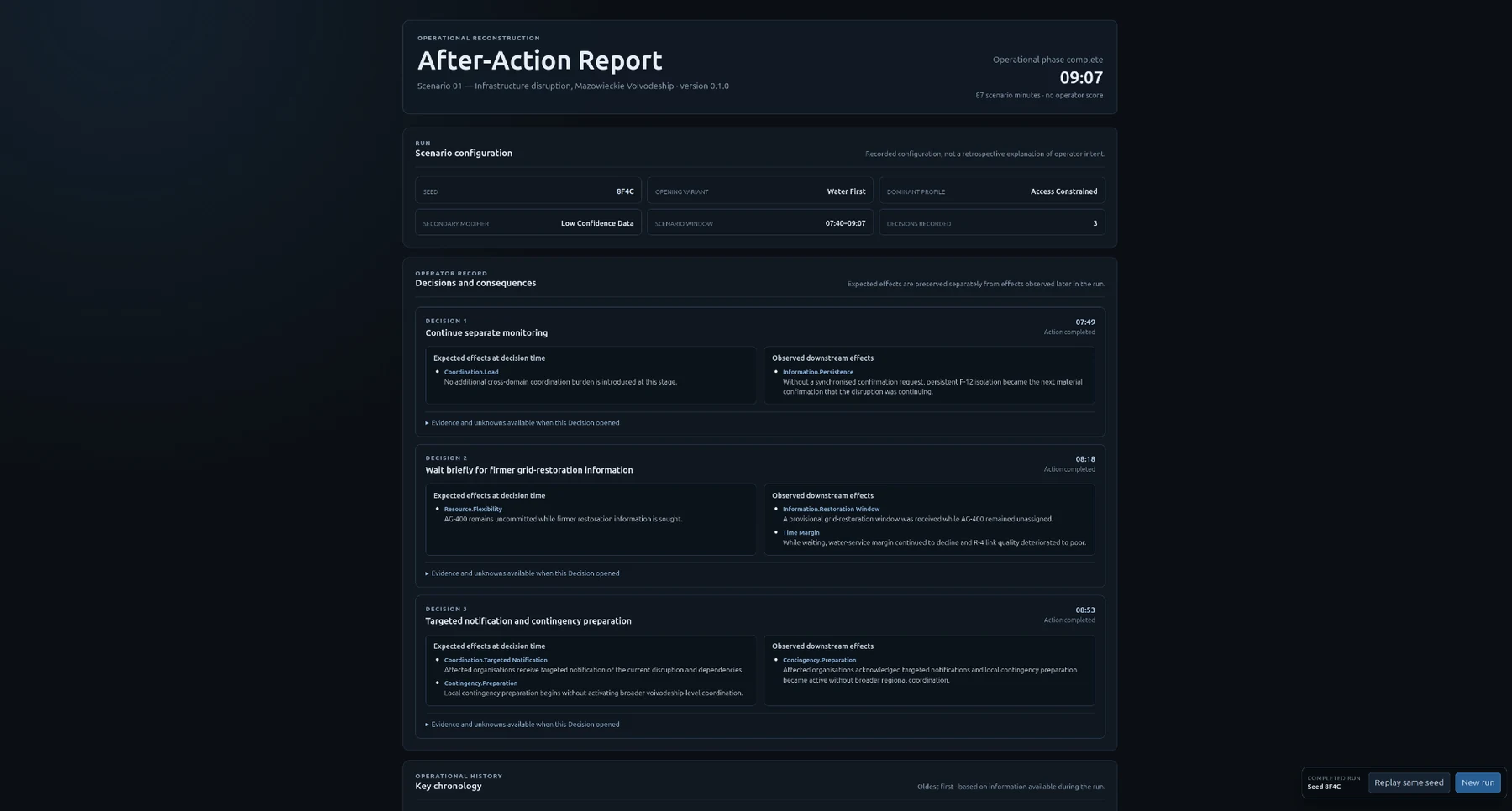
Current boundary
The current release is a deliberately bounded public alpha. Its core system model, runtime, dependency logic, decision flow, and consequence propagation are implemented; production capabilities such as real operational integrations, live public-safety data, multi-operator collaboration, and broader scenario coverage are not yet part of the release.
That distinction matters: synthetic data and a constrained scenario limit the deployment context, not the depth of the implemented system. The alpha is a credible vertical slice that can be extended with additional data sources, modules, scenarios, and operational capabilities while preserving the underlying interaction and domain model.
What this project demonstrates
VECTOR OPS is as much about the process as the interface: researching an unfamiliar operational domain, challenging an initial concept, defining system and interaction contracts, making scope trade-offs, implementing the result, and validating a working release.
The current alpha demonstrates the complete path from research and domain modelling through runtime logic, interaction design, implementation, and validation. Further releases can expand the operational scope, integrations, modules, and scenarios while the underlying system continues to evolve.